Hair Loss Diagnosis & Trichoscopy
Accurate Diagnosis Starts Here
Hair loss and thinning can be emotionally and physically distressing. Understanding why your hair is falling out is the first and most crucial step toward effective treatment. Our advanced diagnostic approach combines a detailed clinical assessment with trichoscopy — a non-invasive, magnified scalp and hair examination that reveals what’s happening beneath the surface.
What Is Trichoscopy?
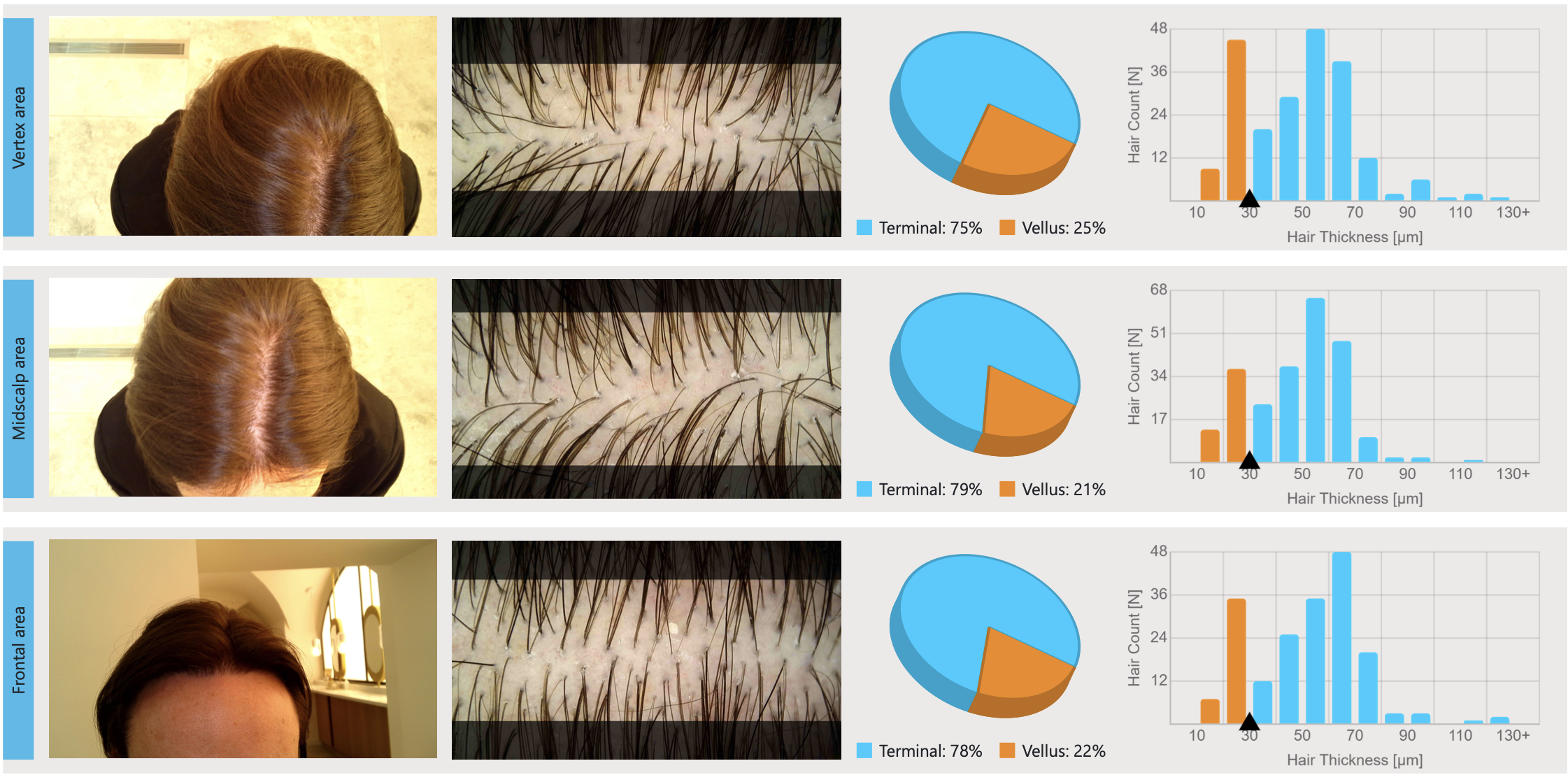
Trichoscopy is a specialised form of scalp dermoscopy that allows clinicians to visualise the hair follicles, shafts, and scalp skin at high magnification. Unlike a routine visual exam, this method reveals subtle diagnostic features not visible to the naked eye, including:
Follicular openings and abnormalities
Hair shaft characteristics
Pigment and vascular patterns
Signs of inflammation, miniaturisation, or scarring
This detailed view supports rapid and accurate classification of hair loss types, empowering personalised care plans tailored to your condition.
How the Diagnostic Process Works
1. Comprehensive Consultation
Every patient begins with a detailed discussion about:
Duration and pattern of hair loss
Family history and medical factors
Recent stressors, medications, and lifestyle influences
Understanding your history guides our focus during the examination.
2. Trichoscopic Evaluation
Using specialised dermoscopy equipment, we examine regions of the scalp — frontal, temporal, and occipital — capturing high-resolution images for analysis. These images allow us to detect:
Hair diameter diversity (anisotrichosis)
Broken or dystrophic hairs
Yellow or black dots
Perifollicular scaling and inflammation
These features help distinguish between different causes such as androgenetic alopecia, telogen effluvium, alopecia areata, and scarring alopecias.
3. Diagnosis & Recommendations
After reviewing trichoscopic findings in conjunction with your history, we provide a clear diagnosis and discuss the most effective treatment options for your specific condition.
Why Trichoscopy Matters
Non-Invasive & Painless
Trichoscopy is entirely non-invasive — no biopsies, no discomfort, and no need for sedation. The examination typically takes around 20–30 minutes and can be performed safely on adults and children alike.
Precision You Can Trust
By magnifying hair and scalp structures, trichoscopy enhances diagnostic confidence, and allows us to:
Differentiate scarring vs non-scarring hair loss
Detect early signs before thinning becomes visually obvious
Monitor progression and response to treatment over time
High-quality imaging also provides documentation you can compare at follow-up visits.
Perfect For
-
![pattern hair loss with thinning crown and recession, ideal for hair loss diagnosis and trichoscopy]()
Androgeic Alopecia
Professional assessment for men and women experiencing hereditary hair thinning and receding hairlines. Early diagnosis helps guide effective treatments.
-
![post-partum hair thinning and shedding suitable for professional hair loss diagnosis and trichoscopy evaluation]()
Post Partum Hair Loss
Specialized evaluation for hair shedding after pregnancy. Trichoscopy identifies underlying causes and helps create a tailored hair recovery plan.
-
![pre and post hair transplant assessment to support surgical planning and results monitoring]()
Pre and Post Surgical Transplant
Expert monitoring before and after hair transplant surgery to ensure optimal planning, precise treatment, and healthy results.
-
![prevention of hair thinning and early diagnosis of hair loss using detailed scalp analysis and trichoscopy, North London]()
Prevention of Hair Thinning and Hair Loss
Early scalp and hair assessment to detect thinning before it becomes severe. Personalized strategies help maintain hair density and scalp health.



Treatment Journey
-

CONSULTATION & SCALP ASSESSMENT
Your first visit includes a full medical review and trichoscopic scalp analysis. This gives us the insight we need to recommend the best next steps for your hair goals.
-

PERSONALISED HAIRCARE PLAN
We build a treatment plan that may include compounded solutions, topical therapies, and ongoing monitoring tailored to your condition.
-

Ongoing Support & Monitoring
Hair restoration is a journey — we work with you to monitor progress, adjust treatments as needed, and support long-term hair and scalp health.
-
Trichoscopy is a non-invasive diagnostic technique that uses magnification to examine the scalp and hair follicles in detail. It allows us to identify specific patterns of hair loss, detect early changes, and distinguish between scarring and non-scarring conditions — all without the need for biopsies in most cases.
-
Hair loss can result from many factors, including genetics, hormonal changes, stress, nutritional deficiencies, medical conditions, autoimmune disorders, and certain medications. Because different causes require different treatments, an accurate diagnosis is essential before starting any therapy.
-
Many hair loss conditions look similar but behave very differently. Treating hair loss without a proper diagnosis may delay results or worsen the condition. A professional assessment ensures that treatment is targeted, effective, and safe.
-
No. Trichoscopy is completely painless and non-invasive. It involves placing a specialised camera on the scalp surface to capture magnified images. There is no discomfort, downtime, or recovery period.
-
The examination typically takes 20–30 minutes, depending on the complexity of the case and the number of scalp areas evaluated. Results are usually discussed during the same appointment.
-
Trichoscopy is useful in diagnosing many conditions, including:
Androgenetic alopecia (pattern hair loss)
Telogen effluvium (diffuse shedding)
Alopecia areata
Scarring (cicatricial) alopecia
Inflammatory scalp conditions
It can also help monitor disease progression and treatment response.
-
Yes. For optimal imaging, it is recommended to wash your hair the day before or the morning of your appointment and avoid applying styling products, oils, or sprays to the scalp.
-
Yes. Trichoscopy can identify early signs of follicle miniaturisation and scalp changes before visible thinning occurs. Early diagnosis allows for earlier intervention and better long-term outcomes.
-
Yes. Trichoscopy is suitable for men and women of all ages and is useful for diagnosing hair loss patterns that affect both sexes.
FREQUENTLY ASKED QUESTIONS

“Dermoscopic imaging of my hair and scalp (a trichoscopy) showed a significant increase of average hair density, a significant increase of average hair shaft thickness, and a significant decrease of thin hair count. Basically, the hair density around my crown has already improved, as has the coverage. I was mighty pleased.”
CLIENT TESTIMONIAL